Craftsman Garage Door Repair in Deerfield Beach: A Homeowner’s Guide
If your Craftsman opener was bought after 2019, it’s probably built on a Chamberlain platform and shares parts with myQ-compatible models. Older Craftsman units are a different animal entirely: different logic board, different remote frequency, and parts that most suppliers stopped carrying. That single detail decides whether a repair is cheap or a scavenger hunt. Before you order anything or call anyone, figure out which generation you own. Here’s how. And if you’d rather not climb the ladder yourself, call (855) 210-1282.
How do I tell which generation of Craftsman opener I own?
Find the model number on the label inside the opener housing or on the back panel, then match it to the manufacturing era it came from. That’s the whole trick, and it’s the first thing a technician checks. The model number tells you which parts bin your unit pulls from, and this matters more on Craftsman than almost any other brand because the supply chain shifted underneath it.
Craftsman openers sold through Sears were manufactured for decades under contract by Chamberlain, which also makes LiftMaster. When Sears’ manufacturing arrangements changed, newer Craftsman units were built on the Chamberlain platform and now share logic boards, remotes and accessories with myQ-compatible models. Units from before that shift use a completely different board architecture and remote frequency. Some of those legacy parts are no longer stocked by common suppliers.
What to look for on the label:
- Model prefix: the first characters of the model number identify the manufacturing series and, with it, the parts platform.
- Serial date code: gives you the production date, which is often more useful than the model alone for parts matching.
- Remote frequency: older units run on frequencies newer remotes and wall consoles won’t talk to. A mismatched remote is a common reason a working opener seems “broken.”
- myQ logo: if it’s printed on the housing or the wall console, it’s a newer platform and parts are far easier to source.
Write the model number down before you call anyone, including us. It’s the difference between a real diagnosis and a guess.
What breaks most often on a Craftsman opener in Deerfield Beach?
Heat and humidity do the most damage to Craftsman openers in Deerfield Beach, and the failures follow a pattern: capacitors die from heat, photo-eyes drift out of alignment, and logic boards corrode. None of these are structural failures. All three are fixable on the unit you already own, and none of them mean you need a new opener.
The most common failure modes we see:
- Capacitor failure: the run capacitor on the motor loses capacity in sustained heat. The symptom is an opener that hums or strains but won’t lift the door, or lifts it sluggishly. A capacitor is an inexpensive part. Replacing it is a repair, not a rebuild.
- Photo-eye drift: the safety sensors at the bottom of the track shift slightly with humidity and temperature swings, or get bumped by a trash can. The opener runs a few inches and reverses. Often it’s alignment and a dirty lens, not a dead unit.
- Logic board corrosion: moisture and years of warm air attack the board’s contacts. Symptoms range from erratic behavior to a dead wall console. Whether this is worth fixing depends on the board’s availability for your generation of Craftsman, which is why the model number matters so much.
- Gear and sprocket wear: the nylon drive gear inside chain-drive units wears out over time. It’s a known wear item and a straightforward repair.
Because every one of these shows up differently, the diagnostic order matters. We start with the simplest and cheapest cause and work up, rather than jumping to the board.
Which Craftsman repairs are worth doing, and when is replacement smarter?
A Craftsman repair is worth doing when the part is available and the motor and rail are sound. Replacement makes more sense when a discontinued logic board costs more than the unit is worth, or when two or three major components are failing at once. The calculation is about parts availability, not age alone.
Here’s how we think about it:
- Worth repairing: capacitors, photo-eyes, remotes, wall consoles, drive gears, travel limits and force settings on a newer Chamberlain-platform Craftsman. These parts are sourced easily and the repair restores full function.
- Worth repairing with a caveat: a logic board on a newer generation, where the board is available. Confirm the part number against the model before committing.
- Probably not worth it: a discontinued board on a legacy unit where the only source is used or salvaged parts, especially if the motor is also tired. Spending on a part you can’t replace twice is money you won’t get back.
The honest test is simple: compare the repair quote to the cost of a comparable new opener. If the repair lands well under that and the rest of the unit is healthy, fix it. If the parts math tips the other way, we’ll tell you. We’d rather fix the opener you own, but we won’t pretend a discontinued board is a smart bet.
Why does my Craftsman myQ connection keep dropping?
A Craftsman myQ connection that keeps dropping is usually a Wi-Fi or account issue, not a failed opener. The unit works fine from the wall console and the remotes while the app shows it offline. Check the network and the account before you conclude the opener needs replacing.
On newer Craftsman units built on the Chamberlain platform, myQ connectivity runs through the opener’s Wi-Fi module or a gateway accessory. When the app misbehaves, it’s typically one of these:
- Wi-Fi band or signal: the module connects on a specific band, and a router that’s changed settings or moved can drop it. Distance and wall density in a Florida home matter.
- Router reboot or password change: the module loses its credentials and sits offline until it’s reconnected.
- Account or app state: a firmware update, an app update, or a signed-out account can break the link even when the hardware is fine.
- Gateway accessory: if your unit relies on a separate gateway, that device needs power and a working connection of its own.
Reconnecting through the app and confirming the network is the first step, and it fixes the majority of these cases. If the opener still responds locally but never comes back online, that’s a module-level fault, and it’s diagnosable without touching the door or the springs.
What does a Craftsman-specific diagnostic actually look like?
A Craftsman diagnostic starts with the model number and the error signal from the wall console, which together point to the exact fault. The wall console and the opener’s light pattern report codes that tell a technician where the problem is: motor, board, sensor circuit, or travel and force calibration. Reading the code first saves the guesswork.
What the process looks like in practice:
- Model and serial first: confirms the generation and the parts platform before anything is opened.
- Code sequence: the number of console or light flashes corresponds to a fault category. A technician matches the sequence to the service reference for that model.
- Manual release test: with the opener disengaged, the door should move by hand with reasonable effort. If it doesn’t, the issue may be the door and springs, not the opener, and that changes the whole diagnosis.
- Electrical and sensor checks: capacitor, board contacts, photo-eye alignment and the safety reverse test.
- Travel and force settings: confirmed last, because a mis-set limit imitates a mechanical failure.
That sequence is why a brand-aware technician gets to the answer faster. Our technicians have up to 12 years of experience and are trained on eight major residential brands, Craftsman among them, so the code and the model tell them where to look instead of where to start looking.
When to call a pro
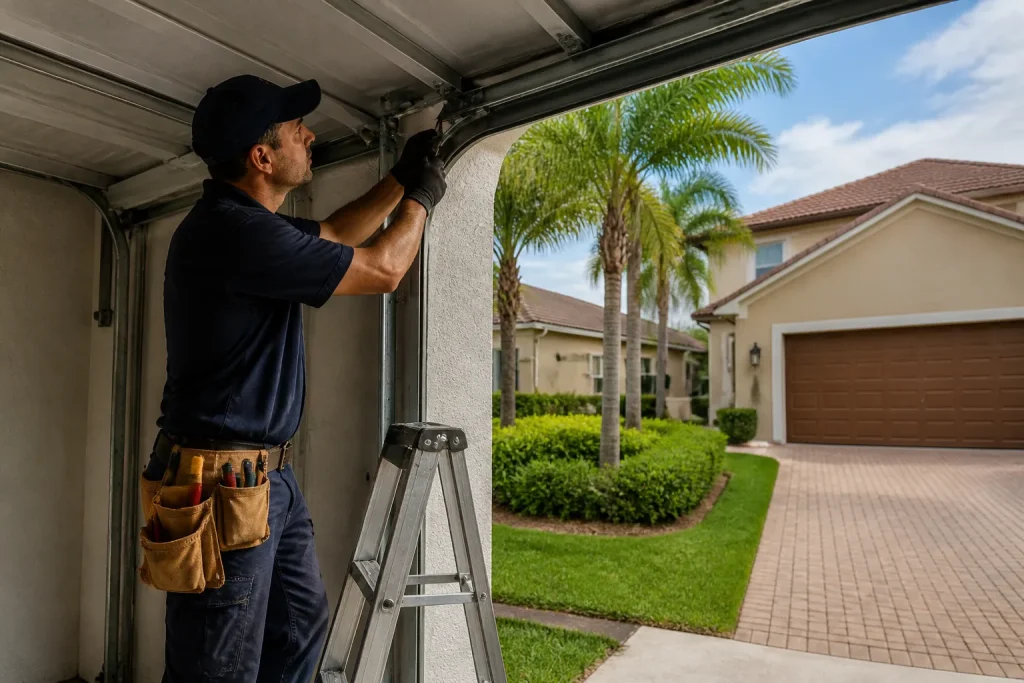
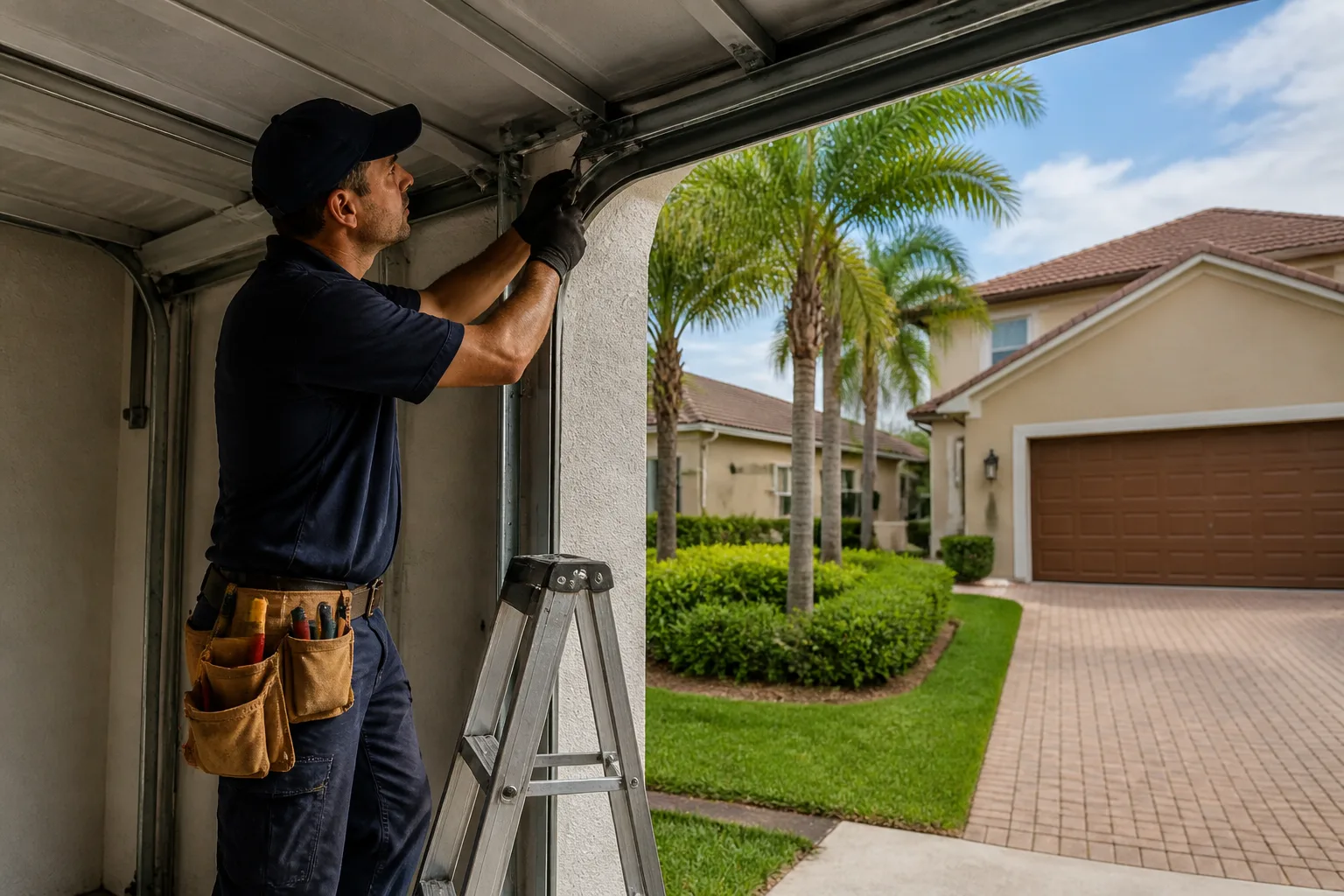
Call a pro when the problem is electrical, when the door itself is involved, or when the springs are. A capacitor, a logic board and the opener’s internal wiring carry mains voltage, and a technician can test them safely with the right tools. The springs are the bigger concern: torsion and extension springs are under extreme tension, and a broken spring is not a DIY item. If the door feels heavy by hand or won’t stay up, stop and call rather than trying to force it. Our garage door spring repair is handled as a safety-first specialty, because that’s what it is. For the opener itself, garage door opener repair covers everything from legacy remotes to smart-home modules. And if the door has come off track or a panel is damaged, that’s garage door repair. You can see the full scope on our Deerfield Beach Garage Door Repair Pros home page.
Related services in Deerfield Beach: opener repair, spring repair and door repair across Deerfield Beach, whether you’re near the Intracoastal, west toward the Turnpike, or anywhere in between.
The Bottom Line
Identify your Craftsman’s generation before you spend a dollar on parts. The model number tells you whether you’re working with a newer Chamberlain-platform unit with easy parts, or a legacy unit where the board and remote frequency are the hard part. In Deerfield Beach, the failures themselves are usually predictable: capacitors, photo-eye drift and board corrosion from heat and humidity, plus the occasional connectivity hiccup on newer myQ models. Repair-first is the right default when the part is available. Replacement is the honest answer when it isn’t. Either way, you should know which it is before you commit.
If you’re in Deerfield Beach and need help, Deerfield Beach Garage Door Repair Pros offers free estimates. Call (855) 210-1282 and have your model number ready. We’ll diagnose the fault, quote the repair up front, and fix the opener you already own whenever it makes sense to.
Frequently Asked Questions
Sometimes, and it depends on the generation. Newer Craftsman units built on the Chamberlain platform share parts with myQ-compatible models and are straightforward to source. Legacy units use a different logic board and remote frequency, and some of those parts are no longer stocked. The model number tells us which bin your unit pulls from. Call (855) 210-1282 with the model handy and we’ll tell you what’s available.
A humming opener that won’t lift usually points to a failed run capacitor or a worn drive gear, not a dead motor. In Deerfield Beach heat, capacitors are a common failure and an inexpensive part to replace. It can also be a door or spring problem masquerading as an opener fault. A quick diagnostic sorts it out. Call (855) 210-1282 for a free estimate.
Repair is usually cheaper when the part is available and the motor is healthy. Replacement becomes the smarter call when a discontinued logic board costs more than the unit is worth, or several major parts are failing together. Any price you get should be quoted and agreed before work starts, with a written estimate setting the final figure. Call (855) 210-1282 to talk it through.
No. If the wall console and remotes still work, the opener is fine and the issue is the network link, the account or the gateway. Reconnecting through the app and checking the Wi-Fi usually fixes it. If it stays offline while working locally, that’s a module fault a technician can diagnose. Call (855) 210-1282 if it won’t come back.
Written by the team at Deerfield Beach Garage Door Repair Pros.
Need Garage Door Help?
Call Deerfield Beach Garage Door Repair Pros - the local pro we connect you with is licensed and insured, here with fast after-hours help in Deerfield Beach.
(855) 210-1282